

Essay writing competition

The International Phytosanitary and Seed Quality Conference 2026 essay competition.
Important dates;
Begins on Monday, 14th September 2026 ends on Thursday, 17th September 2026
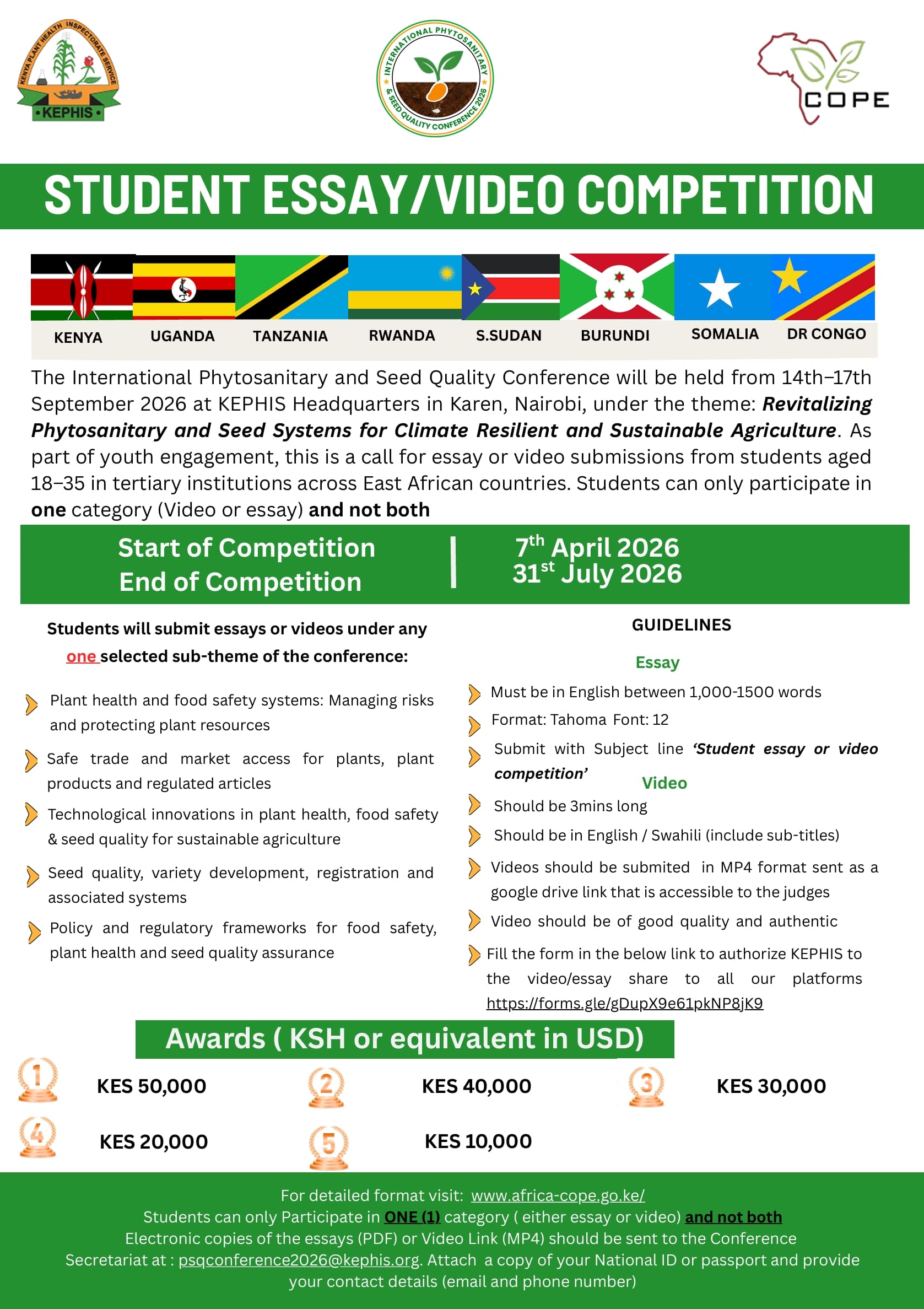
The 1st International Seed Quality Conference - 2024








ISPMS Reference Materials
This page includes all adopted International Standards for Phytosanitary Measures (ISPMs). Always refer to the versions of the ISPMs as linked on the page.
COPE Curriculum

Objectives and courses of the COPE training
The COPE in-service training courses are designed with the objective of enhancing participant's knowledge and skills for the development and maintenance of fully functional and effective national Phytosanitary systems. It further enhances harmonized Phytosanitary procedures for improved regional and international agricultural trade while preventing introduction and spread of pests.
The specific objectives of the course are to:
- Enhance capacity of national Phytosanitary systems to protect national agriculture from introduction and spread of pests of plants and plant products through trade.
- Impart knowledge and skills on the structure, mandate and operations of National Plant Protection Organizations in implementation of Phytosanitary measures.
- Increase African countries’ ability to compete in international markets by meeting market requirements.
- Enhance awareness and understanding of the national, regional and international legislations, standards and agreements supporting Phytosanitary systems.
- Create awareness on international Phytosanitary treaties and standard setting procedures.
- Contribute to sustainable crop production and agricultural trade
Target audience
The training courses are intended for local and international participants with varying levels of Phytosanitary capacity and therefore, the facilitators will be expected to give examples and case studies with an international outlook. To maintain this international outlook, COPE secretariat will strive to invite expert facilitators from both local and international institutions. The actual delivery of the courses will be tailored to fit into the requirements of specific clients from the flower industry, vegetable and fruit industry, grain associations, public and private regulatory agencies, agricultural extension & service providers and trainers in agricultural training institutions of higher learning. Therefore, the course duration, composition and specific content of units will be flexible to satisfy the clients’ needs.
The short-term in-service training courses are open to the following local and international participants:
- Phytosanitary managers and senior technical staff (heads of national plant quarantine service, heads of laboratories, regional Phytosanitary managers, heads of phytosanitary inspection departments) working in National Plant Protection Organizations (NPPOs), agricultural extension services, and other governmental regulatory agencies.
- Subject matter specialists and technologists such as plant pathologists, seed scientists, entomologists, weed scientists and nematologists working in plant quarantine stations and diagnostic laboratories in NPPOs and other phytosanitary regulatory bodies.
- Phytosanitary inspectors and field inspectors working for NPPOs, and other regulatory agencies in Phytosanitary systems.
- Private sector actors including exporters and importers, farmers, agronomists, crop protection practitioners and trainers involved in agricultural production and trade.
- Trainers from institutions of higher learning involved capacity building in agricultural sciences
Each course unit will have exercises and case studies provided at the end of the course. The indicated exercises and case studies are just a guide to the facilitators and the facilitators and participants will be expected to cover examples from various countries from where the participants will be drawn from. Prior to arrival, the participants will be requested to complete a pre-course questionnaire in order to gauge their level of knowledge. At the end of each course unit, the participants will be subjected to evaluation in the form of written quizzes, reports and group presentations.
| # | Course Unit | Duration | Mode of Delivery | Assessment |
|---|---|---|---|---|
| 1 | Introduction to International Treaties and Standards in Phytosanitary systems | 21 Hours | Lectures, exercises, group discussions and presentations, role plays case studies |
CATs, quizzes, reports |
| 2 | Phytosanitary import regulatory systems |
29 Hours
|
Lectures, field practicals, exercises, group discussions, role plays and presentations, case studies | CATs, quizzes, reports |
| 3 | Phytosanitary Export Certification Systems | 26 Hours | Lectures, field practicals, exercises, group discussions, role plays and presentations, case studies | CATs, quizzes, reports |
| 4 | Pest Risk Analysis (PRA) | 40 Hours | Lectures, exercises on use of data bases, group discussions and presentations, practicals, case studies | CATs, quizzes, group reports |
| 5 | Pest surveillance in Phytosanitary system | 33 Hours | Lectures, exercises, group discussions and presentations, field practicals, case studies, field visits | CATs, quizzes, group reports, examination |
| 6 | Pest Diagnostics in Phytosanitary systems | 34 Hours | Lectures, laboratory exercises, field visits | CATs, quizzes, reports |
| 7 | Emerging Biosecurity issues in Phytosanitary systems | 24 Hours | Lecture, exercises, group discussions presentations, practicals and case studies | CATS, quizzes, group reports |
| 8 | Management of Phytosanitary systems | 11 Hours | Lectures, exercises, group discussions, presentations and case studies | CATs, group reports |
| 9 | Plant variety development and seed certification in Phytosanitary systems | 23 Hours | Lectures, field visit, exercises, presentations and practicals, case studies | CATs, quizzes, practical and reports |
| 10 | Agricultural Export Business | 11 Hours | Lecture, exercises, group discussions and presentations | CATS, quizzes, group reports |
| 11 | Phytosanitary capacity evaluation (PCE) tool | 9 Hours | Lectures, exercises using PCE software, group discussions and presentations, case studies | Group Reports |
| 12 | Introduction to Bioinformatics | 40 Hours | Lecture, exercises, group discussions and presentations | CATS, quizzes, group reports |
| 13 | Fruit Tree Nursery Certification | 14 Hours | Lecture, exercises, group discussions and presentations, field visits | CATs, quizzes, reports |
| 14 | Application of international quality standards for fresh fruits and vegetables | 24 Hours | Lecture, exercises, group discussions and presentations, laboratory exercises | CATs, quizzes, reports |
| 15 | Seed Potato Production and Certification Course | 40 Hours | Lecture, exercises, group discussions and presentations, laboratory exercises | CATs, quizzes, reports |
| 16 | Course on analysis of pesticide residues and pesticide formulation by use of HPLC, GCFID, GCMSMS and LCMSMS | 10 Days | Lecture, exercises, group discussions and presentations, laboratory exercises | CATs, quizzes, reports |
Training outcomes
At the end of the training course, the participants will:
- Understand concepts of Phytosanitary systems
- Understand the relevant international treaties and their impact on application of Phytosanitary measures.
- Have knowledge of national, regional and international phytosanitary standards and evaluation of national capacity to implement these standards
- Have knowledge on the use of the Phytosanitary capacity evaluation tools in strategic planning
- Have improved capacity to carry out pest surveillance.
- Understand risk and risk based application of Phytosanitary measures.
- Understand concepts and procedure for undertaking pest risk analysis (PRA) and its implications for import regulation.
- Be able to use relevant software to strengthen decision making in PRA
- Have knowledge on import regulation within framework of national bio-security.
- Have improved skills in diagnosis and identification of pests of Phytosanitary significance.
- Have enhanced capacity to efficiently carry out the management functions of NPPO and implementation of Phytosanitary regulations.
- Have increased awareness on private standards and their implications on international agricultural trade
COPE Consultancy Services

Phytosanitary Consultancy
Plant protection services in reference to The Plant Protection Act, CAP 324, Laws of Kenya ensures that harmful organisms are NOT introduced or spread when importing plants, plant products and regulated material into the country. Under the Agriculture (Export) Act, Cap319, laws of Kenya, agricultural produce exported should not introduce harmful organisms and noxious weeds into foreign destinations.
- Advisory on pest risk analysis (PRA).
- Guidance on compliance with international phytosanitary standards (e.g., ISPMs).
- Export/import certification processes.
- Development of inspection protocols for export/import crops.
- Pest identification and management.
- Phytosanitary Capacity Evaluation.
- Advisory on Digitization processes including e-phyto, arc GIS and remote sensing.
- Advisory on compliance.
- Phytosanitary treatments.
- Surveillance emergency response and contingency plans.
Seed Quality and Certification Consultancy
- Support in setting up seed testing laboratories.
- Accreditation of seed certification services.
- Training on seed certification procedures.
- Advisory on seed policy and regulation.
- Support for seed enterprises to meet certification standards.
- Providing seed testing services.
Plant Variety Testing and Protection
- Support in setting up plant breeder rights offices.
- Support in development of variety testing protocols.
- Training on plant variety testing and protection.
- Support in genetic purity testing.
Laboratory Services Consultancy(ACL).
- Support in setting up testing laboratories
- Authorization of testing laboratories (seeds, pesticide residues, plant pathogens)
- Provide guidance on accreditation of testing laboratories
- Setting up residue testing programs (e.g., Maximum Residue Limits – MRLs)
- Laboratory research services
- Capacity assessment of laboratories
- Diagnostic services for pests, diseases, and GMOs
- Capacity building in lab techniques and quality assurance systems
- Training in Good Agricultural Practices (GAPs)